UTG Vodnik in the newspaper Delo
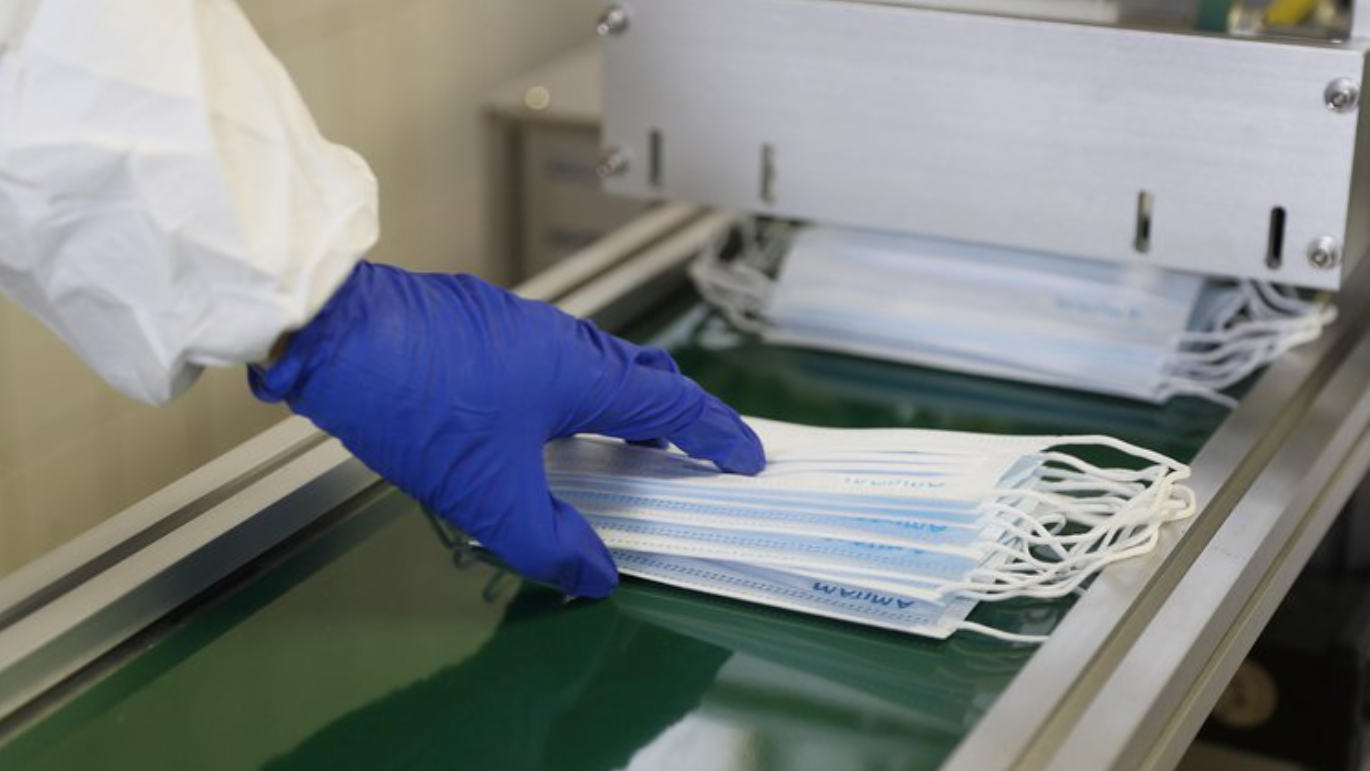
The shortage of protective equipment is also being eased by companies manufacturing in Slovenia. PHOTO: Leon Vidic/Delo
At the beginning of the year Slovenia still had no domestic production of protective masks, so we imported them from abroad and prices went through the roof. At present there are several mask manufacturers in Slovenia, and the response to their products has been outstanding. They make them in different parts of the country and sell both at home and abroad. Buyers are mainly companies, universities and some state institutions, and sales could be even better if government tenders were more realistic, the manufacturers stress. At the national level, despite successful domestic production, we therefore remain dependent on other countries.
In March the company Matima launched production of surgical protective masks in Postojna and is one of four mask manufacturers in Slovenia. It employs 30 people, 12 of them in production. According to its director Borut Dolenc, the experience with production and sales is good, and the response from customers and pharmacies is good too. The latter have had problems with mask quality in the past.
Certificates and quasi-certificates
The Postojna manufacturer sells its protective masks mostly in Slovenia, where the main buyers are companies, private schools, universities and some state institutions. Dolenc says they have a few customers from abroad, and an online shop is also active, where individuals can buy masks. For now Matima produces type 2 masks, but it expects shortly to receive a certificate for the highest protection level, type 2R, where the fabric retains 99.22 percent of bacteria. Type 2 masks are also made by the family company UTG Vodnik from Domžale, which obtained its certificate in August this year. The company director Uroš Vodnik says that production takes place entirely in Slovenia, and that the production of personal protective equipment has been the company's core business for four decades.
The Kranj company Le-Tehnika can already boast a certificate for the highest level of protection. Its majority owner Drago Lemut says they can produce a little over 30,000 masks a day and can double production in a short time. Le-Tehnika, too, sells its masks mainly in Slovenia, and in the current circumstances it is already noticing increased demand.
Obtaining certificates takes several months, and a certificate confirms that a mask really does provide protection. Dolenc stresses that since March the market has been flooded with washable masks that have neither certificates nor proof of protection. "The same goes for home-made masks, which are usually single-layer and as such protect no one. People expose themselves to contact, convinced that they are protected, but they are doing harm to themselves and others," warns Dolenc. Lemut, meanwhile, also warns about masks with quasi-certificates, which likewise offer no protection.
In April the Prekmurje company ME5 also began producing masks and expects approval of its type 2 certificate in the coming weeks. Its director Danijel Faršang says that sales have been growing steadily all year, but unlike the other two manufacturers, the Prekmurje company sells more than 90 percent of its masks abroad. "Most of our sales channels have been established with companies from abroad, especially from third countries. Otherwise we would rather sell in Slovenia and contribute to the country's self-sufficiency, which for now is nowhere to be seen," says Faršang.
Supply with the help of foreign manufacturers
The self-sufficiency of European countries was much discussed during the spring wave of infections, when protective equipment was in short supply across Europe. Now it seems this topic is no longer current. Despite functioning domestic production, it is practically impossible to apply to commodity reserve tenders, domestic manufacturers of protective equipment warn. In the latest commodity reserve tender, masks were offered to the state for purchase at 0.44 euros, and Dolenc stresses that at such a price Slovenian companies cannot even get the material to make a mask, let alone sell the finished product.
Drago Lemut also warns that the state is proving a poor supporter of domestic production, since most protective masks are imported from China. Prices in state tenders are now so low that only companies from eastern countries can take part, adds Uroš Vodnik, who is worried about the lack of oversight of the actual certificates. "I am surprised by the strikingly low prices of masks that are supposed to have all the necessary certificates. I also wonder who actually checks the validity of these certificates," says Vodnik.
Regarding foreign competition, Slovenian manufacturers nevertheless stress that their products can compete strongly on quality. Dolenc therefore points out: "Our goal is above all to provide quality masks, from the elastic bands to the filters. We are obtaining international protection certificates, which raises the added value of our products, but tenders and the market mainly look at price. For now nothing has been done on self-sufficiency at the national level; tenders work on a simple principle: whoever is cheaper wins."
Printing protective visors
In the first wave the shortage of protective equipment was so great that even companies that otherwise have nothing to do with it began making it. Such is the story of the Petrič printing house, which made several thousand protective visors in March and April and, owing to high demand, is still making them today. "We learned online that employees at the Trbovlje hospital were making protective visors themselves, as they simply could not be obtained in spring. We work with UV technology and also have experience with printed plastics, so we tried designing visors, and it worked. We then donated a hundred visors to the Trbovlje hospital, and soon afterwards we received the first inquiries. In the end we also exported visors to neighbouring countries, and to date we have sold more than 20,000," says the printing house director Pino Petrič, describing the start of production. In recent weeks demand has risen again after the summer drop, says Petrič; the main buyers are still various institutions, health centres and care homes.
While protective masks and visors are in great shortage, the situation with disinfectants has always been stable, claims Zoran Jerala, executive director of Kimi, the largest Slovenian manufacturer of medical disinfectants. He says they expanded their plants as early as February because they expected the crisis, and that this month they also have somewhat more business. The Chemicals Office also helped prevent a shortage by issuing permits for the use of around 150 alcohol-based disinfection products. As a result the market is stocked with products that allow only basic disinfection, without more demanding tests, so there is no shortage.
You can read the original article on the website of the newspaper Delo HERE.