
How to wash a waterproof softshell work jacket?
Whether you have a summer jacket that has got dirty or a winter one that already smells, a cycle in the washing machine is a great way to give it new life! Many people are afraid of washing waterproof clothing, but if you follow a few guidelines, there is nothing to fear.
WASHING WATERPROOF GEAR: FREQUENTLY ASKED QUESTIONS
Why do people say that washing waterproof clothing damages the water-repellent finish?
Waterproof fabrics are made of laminated or bonded layers and are then usually treated with a water-repellent substance. The outer layer is usually made of polyester or nylon, while the inner layer is a polymerised waterproof membrane. Washing on an intensive cycle or at a high temperature, or using certain types of detergents or products, damages the membrane and can also strip or weaken the water-repellent coating on the outside of the fabric. So yes, washing done incorrectly can sometimes reduce a product's waterproofness.
What is this "membrane" made of and how does it work?
Most waterproof membranes are made of PTFE (polytetrafluoroethylene) or TPU (thermoplastic polyurethane). PTFE is heated and then stretched rapidly to create a microporous film whose pores are 50 times smaller than the smallest water droplets, so liquid water cannot pass through. Water vapour, however, can. This means that sweat leaving the skin as vapour can escape, while water cannot get in. In TPU membranes a solid barrier is formed that stops water from passing through, but the material can absorb water vapour molecules and let them out by diffusion. This is known as breathability (vapour is let out) and waterproofness (water is not let in).
What is a water-repellent coating?
A durable water repellent (DWR) finish is a substance that coats the fabric of many waterproof garments. It can be made from PFC compounds such as PTFE, or from more environmentally friendly fluorocarbon-free substances obtained through biological processes.
This coating works because it has what is known as a low coefficient of friction. Put simply, it is very smooth, so water does not cling to it. The coating, which is invisible to the eye, stops water from sticking to the fabric and soaking into it, so you stay dry for longer.
So is washing waterproof clothing safe?
Yes, it is. Modern waterproof clothing is designed to be machine washed, and most washing machines have settings that suit waterproof garments. By using the appropriate machine settings and following the instructions on the care label, you can make sure your clothes are protected from damage.
Do I need a special detergent?
We definitely recommend one. For the best and safest results, use a detergent designed specifically for use with waterproof clothing. Many standard detergents will break down the DWR coating and damage the waterproof membrane, so do not use them! Fabric softeners, bleach and other washing products will damage it in the same way. So if you want to keep your jacket or trousers in top form, reach for a detergent designed specifically for waterproof clothing.
HOW TO WASH WATERPROOF PRODUCTS
Step 1: Prepare your workwear
Before washing waterproof workwear, there are a few quick steps that will help you get the best possible wash. First, turn out and empty all the pockets on your work jacket or work trousers. This is important. Then the garment needs to be turned inside out. Since the water-repellent coating wears off fastest through rubbing, we want to prevent that during washing!
Once the jacket is turned inside out, make sure all the zips are closed. That means the front zips, collar zips, hem zips and hood zips. The pockets can stay open: they are attached to the lining, and if you leave them open you will also be able to clean out any remaining debris or dirt in them!
Step 2: Load the machine (but don't really fill it)
We always recommend washing waterproof workwear separately or together with other waterproof items. So if it is two waterproof work jackets, that is fine. A waterproof work jacket and waterproof work trousers together are no problem either. But do not throw waterproof clothing into an ordinary wash!
 Step 3: Set up the machine
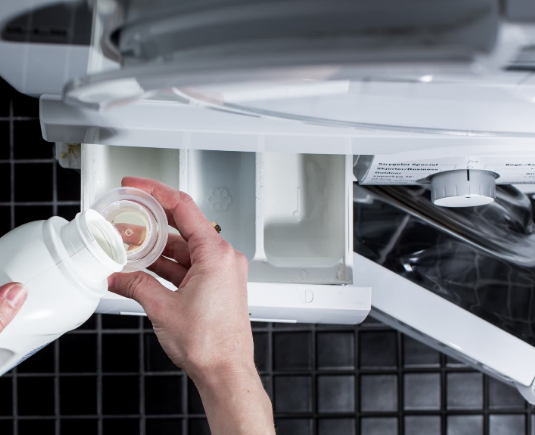
If your machine has a setting for waterproof clothing, use it! If not, it may have a setting for delicates, silk, synthetics or wool, which is often just as good and will not be too intensive. Just make sure the temperature is no higher than 40 degrees and that the fast spin cycle is not switched on.
The safest method is to select the hand wash programme. Start with a short cycle (such as the cycle for delicates, synthetics, silk or wool) – you do not need hours in the machine to wash a single garment! About 30 minutes is usually enough, but your machine will know best what to do. Then lower the temperature to 20 or 30 degrees Celsius – you can check the maximum recommended temperature on the care label of the particular product. Reduce the spin speed to 200 rpm or, if you prefer, switch it off entirely. Add a detergent that is safe for waterproof fabrics. Then close the machine and start the cycle!
Step 4: Hang it up to dry
If no stains are showing on the work jacket, take it out of the machine. If you see some residue, don't worry, that is normal if you did not spin or used a low-spin cycle! In that case, set the machine to a rinse cycle, reduce the spin to a low speed or switch it off again, lower the temperature and run it without adding any detergent. After that the garment should be truly clean.
When you pull the jacket out, it will be wet. So take a bucket or a tray and place it in front of the machine. If you do not have one, hold the garment over a sink for a minute or two until the dripping eases. You can also gently squeeze the item so the water drains faster. But do not wring or twist it!
Once the dripping settles, find a place where you can hang it to dry, still turned inside out. Outside is best, which usually also means you do not have to deal with all the water that will run out of it! But it works just as well indoors, although you may need to put a bucket under the drying work jacket.
Do not be tempted to put a hanger inside it and use it straight away, as the jacket can still be quite heavy with water. It is best to hang it by the hanging loop on the collar until all the excess water has drained off. If that is not possible, a good alternative is to lay it over a fence or even on a flat, clean surface.
Once it goes from soaked to damp, you can move it onto a hanger and let it dry completely. If you are drying indoors, an open window or door will allow airflow so the work jacket dries more easily.
Once the lining is dry, you can turn the jacket the right way out and let the outside dry now as well. A word of warning, though – do not let the jacket dry in direct sunlight! If at all possible, keep it in the shade.
Step 5: Check and refresh the DWR system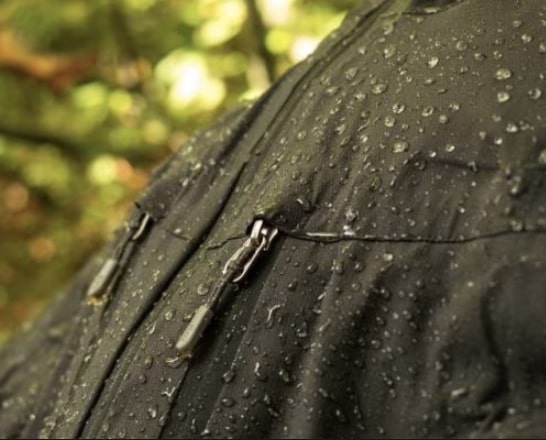
Once it is dry, you can quickly check the DWR treatment. If you have a spray bottle, it makes a very good test. Spray a fine mist of cold water onto the jacket and check whether the water beads up and runs off the surface or soaks into the fabric. If you do not have a spray bottle, pour some water into your hands and flick a few drops onto the material.
You want to see the water bead up and run off the surface of your jacket. If that happens, your DWR protection is undamaged! If it starts to soak into the fabric, it is time for a refresh. Simply throw the jacket into the tumble dryer and dry it on a medium temperature for about 20-30 minutes. This will reactivate and refresh the existing DWR treatment, so the jacket will be ready to go out as good as new.
Repeat the mist test and check the difference! The water should now gather into beads as expected. If not, it means your DWR protection wore out long ago and it is time to reapply it. In that case, don't worry, this is completely normal!
Step 6: Reapplying the DWR system
If your work jacket or work trousers have been worn for a good while, there is a high probability that part of the DWR has worn off during use. If that has happened, now is the right time to reapply the DWR coating.
You can see all our waterproof workwear here. If you are not directly exposed to water at work, water-repellent workwear may be enough for you. You can also view all the workwear we have in stock in our store in Vir near Domžale, where our advisers will help you choose. Visit us, or contact us at info@utg-vodnik.si or on 01 724-82-58. You are welcome!