
How to choose the best safety helmet for a hot summer
One of the key aspects for people working outdoors in summer is head protection. According to recent studies, the colour of the plastic part of a safety helmet is actually directly linked to the heat that affects the body. This guide explains three key steps that help safety managers choose the right safety helmets to protect outdoor workers in the hottest months of the year. (Information from Honeywell)
1. ASSESS THE HEAT RISK style="margin: 20px 50px; width: 600px; height: 380px; float: right;" />
According to the Occupational Safety and Health Administration (OSHA), temperatures as low as 22 °C can already be dangerous for people doing physical exertion. This is because the outdoor air temperature - the reading on the thermometer - does not tell the whole story of heat risk. Other contributing factors are direct sunlight, relative humidity and radiant heat reflected from water, windows or metal structures.
So when assessing heat hazards for outdoor workers, bear in mind that workers can still be at risk even when the ambient temperature seems pleasant.
2. CHOOSE A LIGHT-COLOURED SAFETY HELMET
All safety helmets reflect, absorb and transmit some of the sun's infrared rays. The rays absorbed through the shell are trapped and raise the temperature around the worker's head. The temperature is raised by various factors, including the angle of the sun, the amount of wind, the ambient temperature and the colour of the safety helmet.
Honeywell tested the effect of colour on the temperature to which a worker is exposed. Identical safety helmets in different colours were placed on mannequin heads in a controlled environment set up to resemble a warm summer day. The helmets were then exposed to an infrared heat lamp simulating the sun. Thermocouples were attached to the outside of the helmet shell and inside the shell, just above the mannequin's head. Honeywell found that in an environment of 32 °C the temperature under the helmet shell (the air to which the worker is actually exposed) ranged from 44.2 °C to 50.2 °C.
They therefore found that, depending on colour, the outer shell of a helmet can be 15 degrees warmer than the ambient temperature, while the temperature inside the helmet can be more than 30 degrees higher than ambient. Clearly, choosing a light-coloured safety helmet can greatly affect a worker's health and safety at high temperatures.
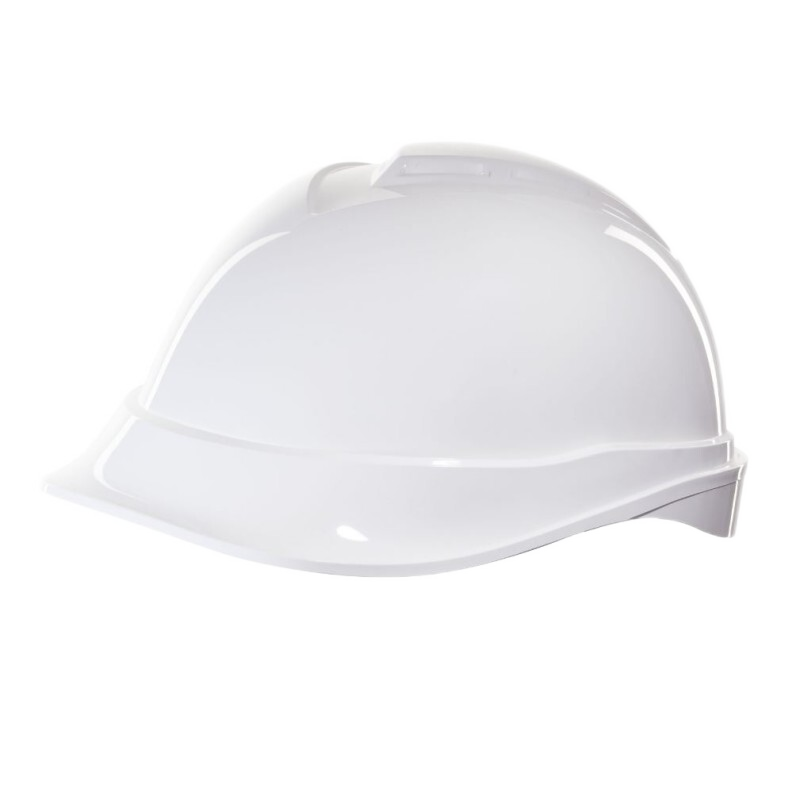
How does the colour of a safety helmet contribute to heat risk? Honeywell's studies show that in a hot environment the temperature around the worker's head is lowest with white safety helmets and highest with orange or high-visibility yellow ones.
Honeywell repeated these results by placing several safety helmets on mannequin heads in warm, sunny environments around the world. The sunlight experiments produced data consistent with our controlled tests.
In summary, the head under light-coloured helmets was significantly cooler than under darker ones. Interestingly, orange performed worst, allowing infrared rays to pass through the shell and creating the highest temperature in the air gap around the worker's head. White compared favourably with all other colours, which makes it the ideal helmet colour for reducing heat risk. Across the whole spectrum, a good way to improve workers' safety in the heat is to replace darker helmets with lighter-coloured ones.
3. CHOOSE A SAFETY HELMET WITH VENTS (VENTED)
Safety helmets with vents are optimal for work on hot summer days, as they effectively improve airflow and dissipate heat, reducing the risk of the body overheating. They also contribute to the worker's greater comfort and productivity and reduce the chance of heat-related injuries, which together increases safety in the workplace.
The specialists at UTG Vodnik d.o.o. are happy to help you choose the most suitable safety helmet or other protective equipment for your needs. We are committed to helping you meet compliance requirements, reduce injuries and protect the wellbeing of your workforce. You can view part of our safety helmet range at this link, and you can see more in our shop in Vir near Domžale.
Call us on 01 724 82 58 or write to us at info@utg-vodnik.si and together we will find the solution best suited to you or your employees.