
How to choose suitable work gloves?
Today the choice of work gloves is almost endless. Reinforced gloves may perform well for some tasks but be too clumsy for others. Gloves with a rubber-coated palm do well for precision work, but are not always durable enough in other situations.
Different cuts, grip materials and textures will suit certain types of work better than others. So how do you choose the best work gloves for your job?
HOW TO CHOOSE THE BEST WORK GLOVES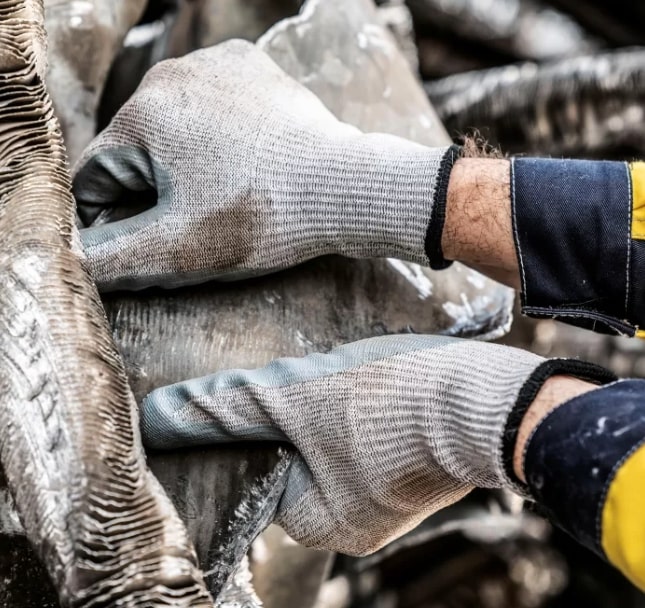
Heavy physical work is demanding enough on its own. Why add cuts, burns, abrasions or nerve injuries on top of it, when they can be prevented?
A little skin protection can make a big difference. Gloves can reduce the chance of hand injuries at work by up to 70%.
However, choosing the right type of gloves for your kind of work can be a real challenge. We usually have to comb through all the different types of gloves to find ones that meet our needs in the workplace and are comfortable to wear.
Below we present a few steps that will help you choose the best work gloves for you.
CHOOSING THE MATERIAL
The first step in finding a work glove is choosing the right material. Depending on your job, you will need different types of materials suited to different tasks.
CUTS AND PUNCTURES
For tasks where you deal with sharp objects and tools, you will need cut-resistant gloves. Cut-resistant gloves will not protect you from every injury, but they can help reduce the chance of cutting your hands while working.
Look for a material with the right thickness and padding for your work. That can mean something simple, such as leather gloves that protect you from cuts. It can also mean something more complex, such as reinforced palms, padded fingers or knuckle guards.
It depends on the injury risk you face.
You can recognise protective gloves that protect against punctures and cuts by standard 388, and you can check our range of cut-resistant gloves here.
 WATER AND CHEMICALS
For jobs where you deal a lot with water or any chemicals, liquid-resistant gloves are necessary.
You need to look for gloves that are waterproof but still allow movement. For maximum resistance, look for materials that do not let water through – they are often coated on the outside with rubber or made of a water-resistant material.
If you do not need complete waterproofing, you can also find gloves coated with a material that helps them shed water. You can view chemical-resistant gloves here.
HEAT AND COLD
For tasks involving heat, such as welding and metalworking, or jobs such as working in a cold store or outdoors in cold weather, you need gloves that will protect you from the elements.
Heat-resistant gloves are made of a durable, flame-retardant material that will protect your hands from sparks. Many metalworking gloves also contain a flame retardant that reduces the chance of the gloves igniting.
Cold-resistant gloves are lined with a material that insulates your hands and keeps the warmth inside the gloves.
ELECTRICITY
In any job that involves working with electricity or hands-on engineering, you can suffer an electric shock.
If you do any work where you are likely to be near live objects, look for a material such as leather or rubber, which reduces the chance of electric shock. Avoid any metals and double-check the materials to make sure nothing is conductive. You can view electrically insulating gloves here.
In our range you will find various types of work gloves to protect against different kinds of risks. You can view our entire range of protective work gloves here.