
EN 511:2006 standard - to protect your hands from the cold
Air temperature, wind speed and moisture pose major challenges for working hands in cold environments. To reduce the effect of these factors, it is important to have suitable clothing and footwear for every working environment. When choosing the right pair of cold-weather work gloves or ordinary winter gloves, it helps to understand how cold-weather gloves are tested and rated for use.
WHAT DOES THE EN 511:2006 STANDARD MEAN?
EN 511:2006 is the general standard for all gloves that protect against cold environments. The standard includes two specific tests for assessing thermal insulation, convective cold and contact cold, as well as other low-temperature performance tests that complement the requirements of the EN 388 and EN 420 standards.
Retaining heat is vital in cold working environments, especially during prolonged exposure to the elements, but not just any glove is suitable for cold weather. The blood in your body is sensitive to temperature changes from as little as 0.5 degrees Celsius!
The European standard for gloves, CE EN 511:2006, sets out the requirements and test methods for gloves that protect against convective and conductive cold down to -50 °C. This cold may be linked to climatic conditions or industrial activity. The specific value of the different performance levels is determined by the particular requirements of each risk class or special field of use.
When the mercury drops, it is hard to keep warm. The skin looks bloodless, our muscles shiver to generate heat and the risk of frostbite threatens the fingers, ears and toes. Retaining heat is therefore vital in cold working environments to prevent cold-related injuries. To balance these factors, it is important to have the right protective gloves for the environment in which you work.
HOW GLOVES ARE TESTED TO MEET THE EN 511:2006 STANDARD
In cold environments it is especially important to protect your hands from frostbite caused by the cold. This standard measures how well a glove withstands convective and contact cold. In addition, water permeability is tested after 30 minutes. Testing for the EN 511:2006 standard therefore consists of three different tests:
1. Convection test
The first test shows how well the glove protects against convective cold (performance level 0-4). Convection is the process of losing heat through the movement of air or water over the skin.
It is tested by fitting a glove sample onto the electrically heated hand of a mannequin, which measures the amount of energy needed to maintain 30 °C and 35 °C in a controlled chamber. The chamber is cooled to 20 °C below the temperature of the heated hand and a constant air flow is maintained. The more electrical power is required, the lower the thermal insulation of the glove.
2. Conduction test
The second test shows how well the glove protects against contact cold (performance level 0-4), that is, the process of losing heat through physical contact with another object, for example a frozen ice ball.
The glove sample is placed between metal plates at different temperatures to measure the temperature drop, also known as thermal resistance.
3. Water penetration test
The third test shows the glove's protection against water penetration (performance 0 or 1, where 0 means "water penetration after 30 minutes" and 1 means "no water penetration after 30 minutes").
The glove sample is fully immersed in water for 5 minutes to measure its permeability. If the glove stays impermeable for the 5 minutes, it receives a level 1 "Pass Rating". If the glove absorbs water during the 5-minute test, it is rated level 0 "fail", or marked with the symbol X.
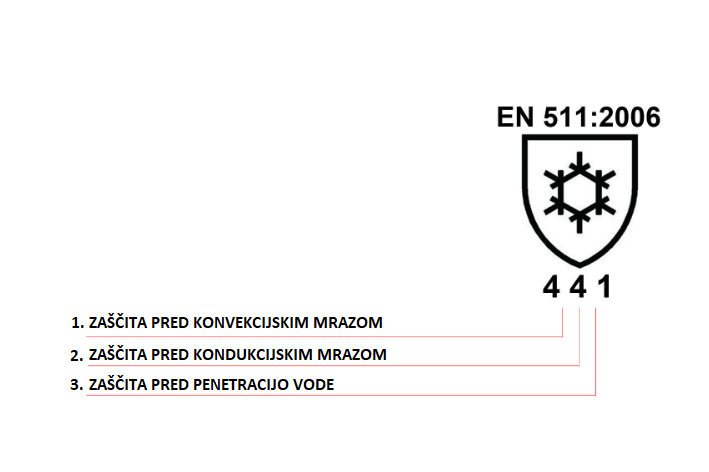
The test results are then shown as markings beneath the EN 511:2006 symbol, where the number 4 indicates the highest level of resistance, while the lowest level or a failed test is indicated by the number 0 or the symbol X. This lets you see what properties the gloves in question have under EN 511:2006. So if you need gloves that protect against cold and also keep water out, you will not pick a rating of 440, but will make sure that the last digit is higher than 1 as well.
Gloves that successfully pass the tests set out in this standard must reach at least performance level 1 in the abrasion and tear tests under EN 388. If gloves reach less than performance level 2, their resistance to convective and contact cold must be stated as level 1 at most.
You can see our cold-resistant protective work gloves here. For other protective work gloves, click here. You are also welcome to visit our store in Vir near Domžale, where you can see the products in stock in person.
For any questions, we are available at info@utg-vodnik.si or on 01 724-82-58.